
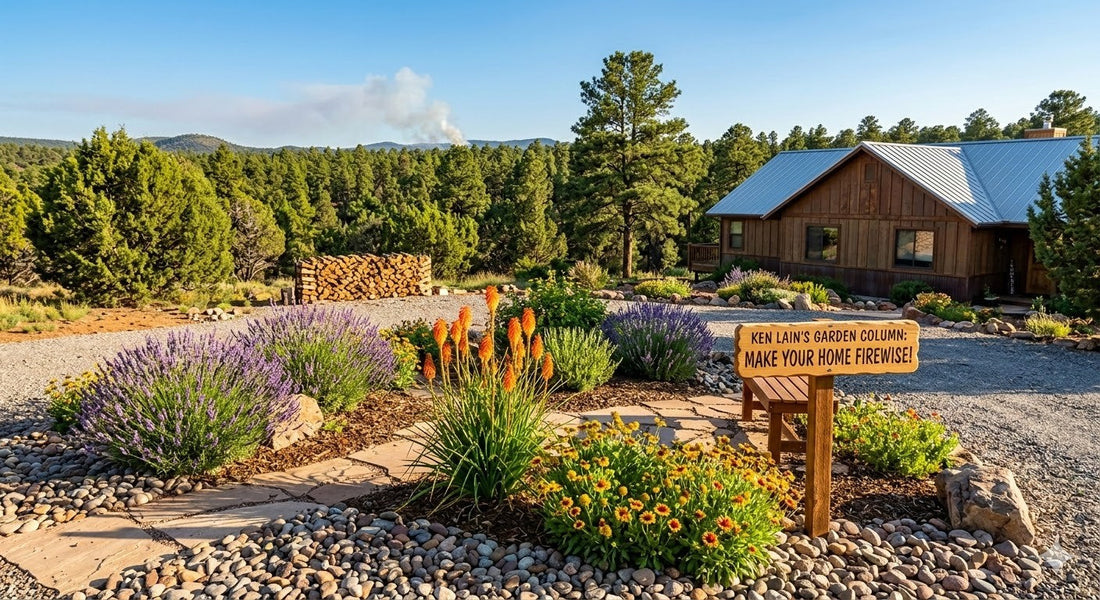
Protect Your Prescott Home: The Art of Firewise Landscaping
by Ken Lain, the mountain gardener
Living among the rolling hills of Yavapai County is a dream. Whether you are tucked into the mature pines of Highland Pines or enjoying the expansive vistas of Yavapai Hills, there is a certain magic to the 'urban-wildland interface.' We share our backyards with deer, javelina, and the occasional lynx, finding solitude in the very nature that surrounds us. However, that beauty comes with a neighborly responsibility: wildfire preparedness.

Many homeowners imagine a wall of flames marching across the forest floor as the primary threat. While that is certainly formidable, the true danger to your structure often arrives long before the main fire. It arrives on the wind in the form of embers and sparks. During a high-wind event, these glowing embers can travel a mile or more ahead of the actual fire, landing in your gutters, under your deck, or against your foundation. Our goal in the garden is to ensure that when a spark lands on your property, it finds nowhere to take hold.
The Strategy of Defensible Space
The top priority for any mountain home is creating Defensible Space. This is a managed buffer zone that changes the behavior of an approaching fire. We want to transition a high-intensity crown fire, one that leaps from treetop to treetop, into a 'slow and low' ground fire that firefighters can actually manage.
Think of your landscape in zones. The first 30 feet around your home is the most critical. This is where we must be the most selective about what we plant and how we maintain it. In this zone, we want to eliminate 'ladder fuels.'
Ladder fuels are exactly what they sound like: a vertical path for fire. Imagine a patch of tall, dry weeds or cheatgrass. If they ignite, they easily catch the low-hanging branches of a shrub, like a sprawling Juniper. That shrub then flares up, igniting the lowest limbs of a Ponderosa Pine. Before you know it, the fire has climbed the "ladder" into the canopy and is dancing on your roof. By pruning the lower branches of your trees up to 6 to 10 feet off the ground and keeping shrubs away from the drip line of those trees, you break the ladder and keep the fire on the ground.
Designing with "Garden Islands"
A firewise landscape does not have to be a barren wasteland of red cinder rock. In fact, a lush, green yard can act as a heat sink, cooling the air and slowing the spread of a fire. The trick is to design with Garden Islands.
Instead of a continuous hedge or a thicket of brush that leads right to your front door, group your plants into intentional islands. Separate these islands with "fuel breaks" like a flagstone patio, a gravel driveway, or a decorative dry creek bed made of river rock. These breaks do more than just stop a creeping fire; they provide vital 'elbow room' for firefighters. When the professionals arrive to defend your home, they need space to move, pull hoses, and stage equipment. A yard choked with overgrown Manzanita and Scrub Oak is a trap; a yard with clear islands is a defensible fortress.
Choosing the Right Plants: Resins vs. Water
Nature has a hierarchy of flammability. Evergreen conifers, your Pines, Spruces, and Junipers, are filled with volatile resins and waxes. These compounds make them hardy in our mountain winters, but they act like gasoline during a fire. If you have a thick, woody Juniper hugging your foundation or growing under an eave, you are essentially storing kindling against your siding.
I recommend replacing these high-resin plants near the home with deciduous varieties. Trees like Gambel Oak, Aspen, Ash, and even certain Maples have a much higher moisture content in their leaves. Think of a campfire: a dry pine branch goes up in a roar of black smoke, while a green, leafy oak branch smolders and resists the flame. Deciduous plants also drop their leaves in the winter, which allows you to rake up that combustible material before the dry winds of June arrive.
Hydration is Your Best Defense
A thirsty plant is a flammable plant. During our dry 'May-gray' and 'June-gloom' periods before the monsoons arrive, your landscape becomes stressed. I advise watering your native trees, like established Ponderosa Pines, once a month during the heat of summer. For ornamental landscape plants such as roses, lilacs, and perennials, a deep soak once a week is essential.
Keeping your plants hydrated raises their internal 'flash point.' It takes significantly more thermal energy to ignite a cell filled with water than a dry, brittle one. A well-hydrated garden can actually lower the ambient temperature of your immediate micro-climate during a fire event.
The "Little Things" That Save Homes
Success is found in the details. Here is a checklist of the often-overlooked hazards:
· The Foundation Zone: Keep the 3 feet immediately touching your house clear of plants and organic mulch. Use decorative rock or pea gravel here. This prevents a wandering ember from igniting mulch right against your siding.
· The Gutter Trap: This is the #1 cause of home loss. Pine needles and oak leaves collect in gutters, forming a perfect tinder bed. One spark on the roof rolls into the gutter, ignites the debris, and the fire crawls right under your roof tiles. Clean them every spring and fall.
· The Under-Deck Storage: We all do it, we tuck the lawnmower, the extra bags of potting soil, or the patio cushions under the deck. In a wildfire, these items catch embers and turn your deck into a bonfire. Keep the area under your decks and eaves completely clear of combustible 'junk.
· Wood Piles: Keep your winter firewood at least 30 feet away from the house. A seasoned woodpile is a massive fuel source that burns hot and for a long time.
· Pine Needle Balance: While we want to rake needles away from the house and gutters, don't strip the forest floor bare under your large trees. Leaving a thin 1-to-2-inch layer of needles over the root zone of a Pine tree helps retain soil moisture and keeps roots cool. Just make sure that the 'duff' layer doesn't lead in an unbroken line directly to your porch.
Protecting your home is a journey of discovery. By thinning the brush, choosing water-rich plants, and minding the "ember traps," you can enjoy the Prescott lifestyle with peace of mind.
Until next week, I'll provide firewise success here at Watters Garden Center.
